
Home/FAQ
Questions
Questions people ask before self-hosting Uchiyomi
Short answers, including the ones where the answer is no. If yours is not here, ask in Discussions.
What it is
Is this a Sonarr or Radarr for manga?
Close enough to be a useful comparison, yes — with one difference. The *arr apps are a stack: Prowlarr indexes, Sonarr watches for new releases, a download client fetches them, FlareSolverr gets past Cloudflare, and Jellyfin or Plex serves the result. Uchiyomi does all five jobs in one container, and unlike Sonarr it also includes the reader, so there is no separate media server to point at the output. People have wanted an *arr stack for manga for years; this is the whole pipeline in one image rather than five services wired together.
Is Uchiyomi a downloader or a server?
Both, and that is the point. Library servers like Komga and Kavita serve files you already have but cannot fetch new chapters. Downloaders like kaizoku fetch chapters but have no reader. Uchiyomi stores and serves your library, and follows series to grab new chapters as they appear, in the same app.
Does it replace Komga or Kavita?
It can, and it does not have to. Uchiyomi reads the same CBZ and CBR files from the same folders, so the two can run side by side against one library while you decide. If you never want automatic downloading and you read on a Kobo, Komga is still the better fit — Kobo sync is a thing Uchiyomi does not do. The comparison page is honest about which rows it loses.
Does it handle manhwa and webtoons properly?
That is what the reader was built for. The default is a continuous vertical scroll that runs on across chapter boundaries, with pinch zoom and per-series settings; paged mode and right-to-left double-page spreads are there for classic manga. Most self-hosted readers are paged-first with a long-strip mode bolted on, which is the wrong way round if you mostly read manhwa.
Sources and legality
Where do the chapters come from?
From sources you choose, by three routes. You can point Uchiyomi at a Mihon or Tachiyomi extension repository you trust and install extensions from it with one click. You can paste a site's URL and let a built-in generic engine handle it, if the site runs one of the common families (Madara, MangaThemesia, Manganato). And MangaDex works out of the box through its official public API. Nothing is enabled until you enable it.
Does Uchiyomi host any manga?
No. There is no content in the image, no content on uchiyomi.com, and no default source or extension repository. An install with nothing configured has an empty library and nowhere to fetch from.
Is this legal?
Reading files you own is. Fetching from third-party sites depends on the site and on where you live, and that part is your call and your responsibility, in line with those sites' terms and your local law. Uchiyomi gives you the tool and enables nothing on your behalf; it is the same position Mihon, Suwayomi and every extension-based reader takes.
Are Mihon extensions bundled with it?
No. Uchiyomi ships the engine that can run them, not the extensions and not a repository to get them from. You add a repository URL yourself, once, and the catalogue appears in the admin panel from then on. Adult extensions stay hidden until you ask for them.
What is FlareSolverr for?
Many manga sites sit behind Cloudflare's challenge page. FlareSolverr runs a headless browser that solves it, so a source that would otherwise fail can be read. It ships alongside the app in the default compose file and is wired up already; if you only use MangaDex you will never notice it.
Running it
What do I need to run it?
Docker and Docker Compose, and somewhere to keep files. Two commands bring up the whole thing, database included — there is no config file to write and no secret to generate, and you create the admin account in the browser on first run. The self-host guide walks through it line by line.
How much memory does it use?
The app itself sits around 300 MB on a real household install with about 240 series and 43,000 chapters in it. The Cloudflare solver is the heavy one, because it runs a browser: give it 2 GB and let it restart when it grows into that. The optional extension engine is a Java server and wants about 1 GB. Without either, 1 GB of RAM is enough.
Does it run on a Raspberry Pi or an ARM NAS?
Yes. Every image is built for amd64 and arm64 natively, so there is no emulation and nothing to compile. Synology, Unraid, CasaOS and Umbrel all work; Unraid users can install it straight from Community Applications.
Do I have to reorganise my library first?
No. Any folder layout works: a directory counts as a series when it directly contains chapters, at whatever depth. Layouts written by Mihon, Komga, Kavita and Tranga are all recognised as they are. Your library is mounted read-only unless you tell Uchiyomi otherwise, so it cannot rearrange anything you already have.
Does it need a separate database?
No. Postgres runs inside the container and persists to a volume, so the default install is genuinely one container plus two optional sidecars. If you already run Postgres and would rather use it, set DATABASE_URL and the embedded one stays off.
Can I put it behind a reverse proxy with HTTPS?
Yes, with any proxy — Caddy, Traefik, Nginx Proxy Manager. The one setting that matters is PUBLIC_ORIGIN: it has to match the address you actually open in the browser, or logins will not stick, because the session cookie is bound to it. How to set it up.
Using it
What file formats does it read?
CBZ, CBR, PDF, image-based EPUB, and plain folders of images. Reflowable text EPUB is deliberately not supported: this is a comic reader, and doing text ebooks properly is a different product. Kavita is the better answer if you want both.
Can my household share one server?
Yes. Everyone gets their own account, their own reading progress, favourites, history and streaks, and a shared leaderboard if you want one. Admins can decide who sees which library and who is allowed to add series at all.
Can I keep adult content away from the kids?
Yes, and it is more than a toggle. Libraries carry an age rating and each member carries a cap, so anything above theirs is invisible to them. An 18+ library stays off the home screen, out of the grid and out of search entirely until somebody with access asks for it — it does not appear greyed out, it is simply not there.
Does it sync to AniList, MyAnimeList or Kitsu?
All three. Connect an account once and finishing a chapter updates your list on its own. Progress is the highest chapter you have finished, so re-reading never rewinds your list, and a tracker being slow or down can never delay your reading. You can also import a list from any of the three to build your library.
Can I read offline?
Yes. Uchiyomi installs as a PWA from the browser, and chapters you save are kept on the device. It opens and reads with no connection at all — on a plane, for instance — and syncs your place when you are back.
Is there an iOS or Android app?
Not a native one yet. The web app installs to your home screen from Safari or Chrome and runs full screen and offline, which covers most of what an app would, and OPDS clients such as Panels, Chunky and KOReader can connect too. Native App Store and Play builds are on the roadmap.
Can I read my Uchiyomi library inside Mihon?
Yes, two ways. There is a dedicated extension for Mihon, any Tachiyomi fork, Tachimanga on iOS and Suwayomi, which reads your library over an API token. Or point Mihon's own Komga extension at Uchiyomi: it speaks a Komga-compatible API, so Mihon's built-in Komga tracker syncs your reading progress back too.
The project
Is it actively maintained?
Yes, and releases are frequent. Every version is listed on the changelog, with what changed and why.
Most recent release: v0.40.0 · 22 September 2026 · Discover answers progressively. Read from GitHub, not typed here, so it cannot go quietly out of date.
What licence is it under?
MPL-2.0. The source is on GitHub, issues and pull requests are open, and source plugins are not part of the repository.
How many people run it?
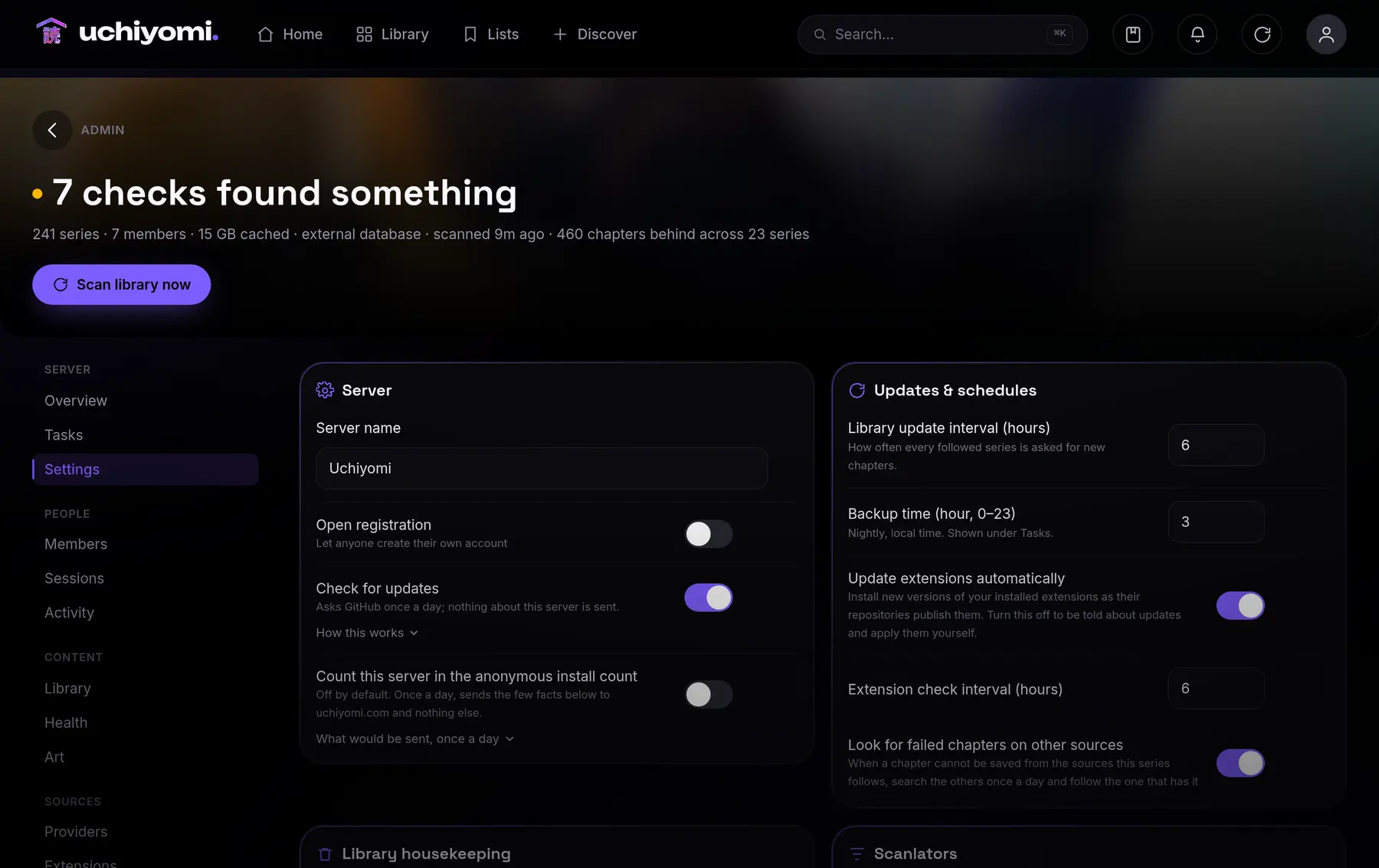
Nobody knows exactly, on purpose: there is no account, no telemetry that runs by default, and the anonymous install count is off unless an admin turns it on. What the servers that did opt in report is published, in full, at the install count.